Biggest Bridges Ranked by Total Length: The World’s Longest Spans Explained
Discover the biggest bridges ranked by total length, including the world’s longest viaducts and famous over-water crossings, with clear explanations of what “total length” really means.
When people hear “biggest bridge,” they often picture the tallest towers or the longest main span. But one of the most measurable ways to rank bridge size is total length—counting the entire structure end to end, including long viaduct approaches across wetlands, bays, and floodplains. Below is a practical, up-to-date guide to the world’s biggest bridges ranked by total length, plus what makes these mega-structures possible.
What “Total Length” Means (and Why It Matters)
Total length is the full end-to-end distance of a bridge structure, typically including all elevated sections (viaducts) and sometimes causeway-like approaches that are built as part of the crossing. This metric is especially important for crossings over shallow water, tidal flats, lakes, and river deltas, where engineers build long sequences of shorter spans rather than one dramatic central span.
- Total length ≠ longest main span (a different ranking entirely).
- Longest total-length bridges are often multi-span viaducts.
- These projects frequently solve flooding, navigation, and land-use constraints in one structure.
Biggest Bridges by Total Length (Ranked)
The bridges below are widely documented among the longest by total length. Lengths are provided in commonly cited figures; exact measurements can vary slightly by source depending on what approach structures are included.
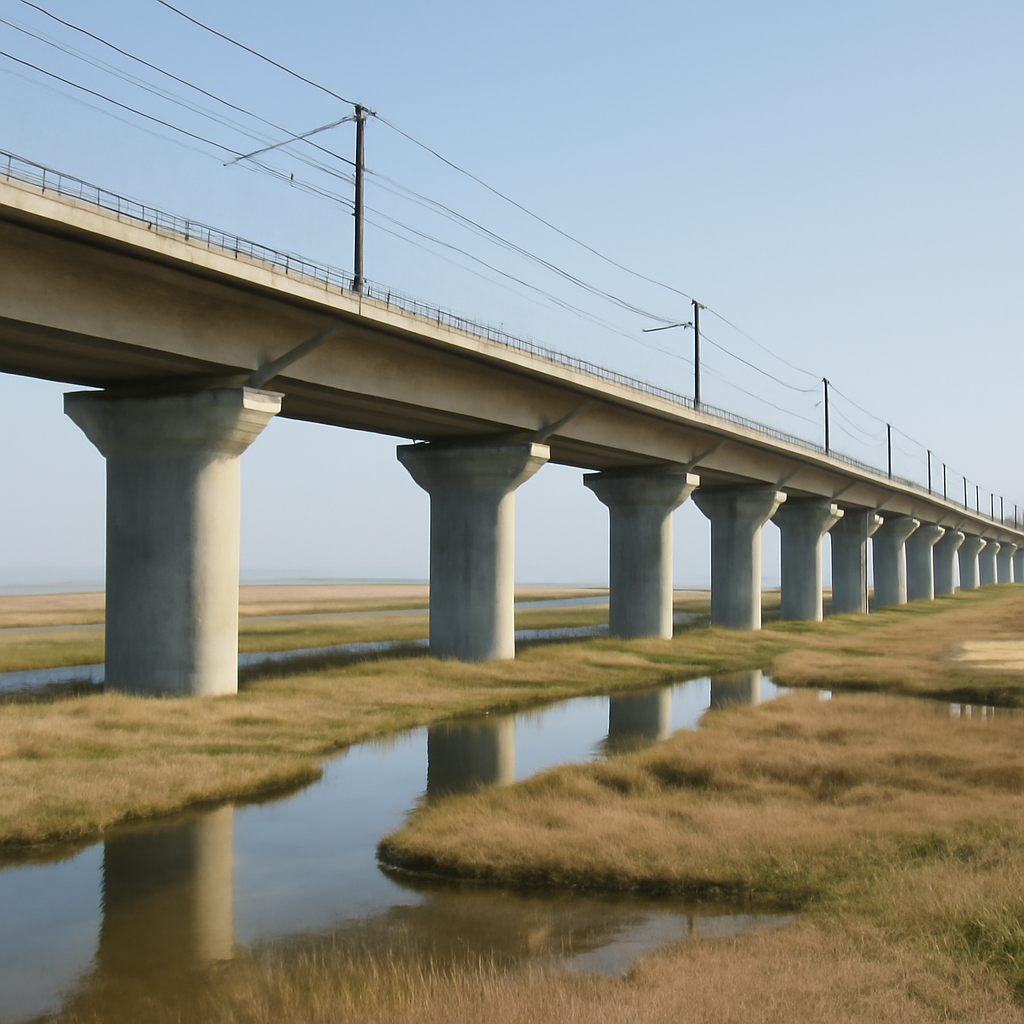
- Danyang–Kunshan Grand Bridge (China) — 164.8 km (102.4 mi). Part of the Beijing–Shanghai High-Speed Railway; a predominantly viaduct-style bridge system across lowlands, rivers, and canals.
- Changhua–Kaohsiung Viaduct (Taiwan) — 157.3 km (97.7 mi). A high-speed rail viaduct designed with strong seismic considerations along Taiwan’s west coast corridor.
- Tianjin Grand Bridge (China) — 113.7 km (70.6 mi). Another major viaduct on the Beijing–Shanghai High-Speed Railway, connecting rail corridors across plains and waterways.
- Cangde Grand Bridge (China) — 105.9 km (65.8 mi). A long elevated section built for high-speed rail operations and ground-condition management.
- Weinan Weihe Grand Bridge (China) — 79.7 km (49.5 mi). A large-scale railway bridge system crossing the Wei River region with extensive elevated segments.
- Bang Na Expressway (Thailand) — 54 km (33.5 mi). A long elevated road bridge/expressway structure in the Bangkok area, often cited among the longest road bridges.
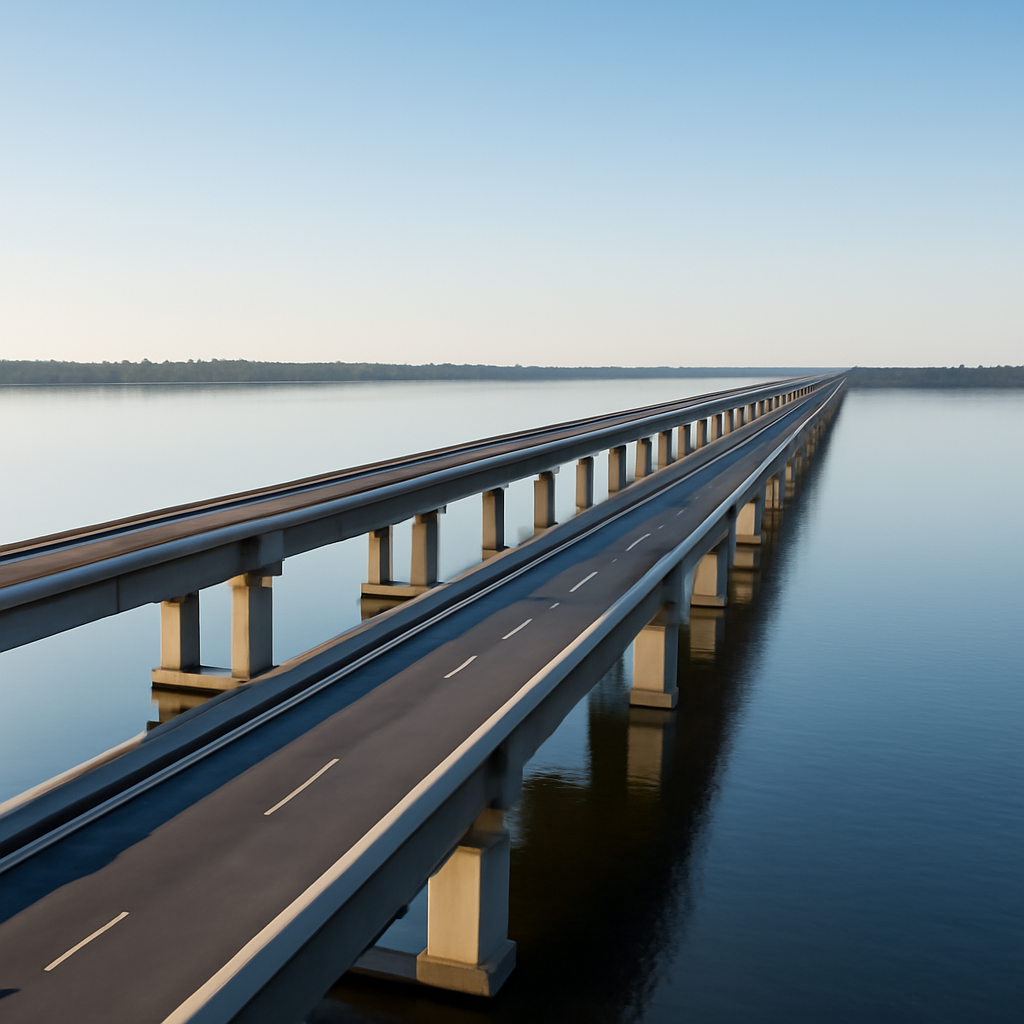
- Lake Pontchartrain Causeway (USA) — 38.4 km (23.9 mi) total for the two parallel spans. A major crossing in Louisiana; the longer of the two spans is often discussed separately in “longest over water” contexts.
Why the Longest Bridges Are Often Rail Viaducts
Many of the world’s longest bridges by total length are built for high-speed rail. Rail lines benefit from straight alignments and gentle grades, so viaducts help avoid sharp turns, road crossings, and unstable ground. Elevating the track also improves safety by separating trains from vehicles and pedestrians and can reduce conflicts with waterways and flood-prone terrain.
- Route straightening: viaducts reduce curves and grade changes.
- Flood resilience: elevated structures can maintain service during high water.
- Land and access: bridges can cross farms, canals, and roads with fewer disruptions.
- Operations: consistent geometry supports higher speeds and smoother rides.
Engineering Challenges at Mega-Bridge Scale
Building a bridge that’s tens—or even hundreds—of kilometers long is less about one heroic span and more about repeating excellence thousands of times. Key challenges include foundations in soft soils, thermal expansion across long distances, durability in wet or coastal environments, and maintaining alignment tolerances for rail.
- Foundations: piles and ground improvement for weak or compressible soils.
- Expansion and movement: joints, bearings, and structural detailing for temperature changes.
- Durability: corrosion protection and concrete quality for long service life.
- Construction logistics: mass production of segments, precasting yards, and synchronized installation.
- Inspection and maintenance: access systems and monitoring across huge distances.
Total Length vs. “Longest Over Water” vs. “Longest Span”
Bridge “biggest” claims can be confusing because different rankings measure different things. Total length counts everything end to end. “Longest over water” focuses on continuous water crossings (definitions vary by organization and source). “Longest span” refers to the single longest unsupported segment between towers or piers—common for suspension and cable-stayed bridges.
- If you care about overall scale and continuous infrastructure: use total length.
- If you care about water crossings specifically: look for longest over-water listings (and check the definition used).
- If you care about structural daring: compare longest main spans.
Quick Takeaways
- The Danyang–Kunshan Grand Bridge in China is widely cited as the longest bridge in the world by total length at 164.8 km (102.4 mi).
- Many of the longest bridges are high-speed rail viaducts built for straight, stable, grade-controlled routes.
- “Biggest” depends on the metric—total length, longest span, and longest over-water are different categories.
FAQs
Q: Are these bridges all one continuous structure? A: In total-length rankings, they are typically treated as continuous bridge structures or viaduct systems forming a single named crossing, though they may contain many sections and expansion joints.
Q: Why do some sources list slightly different lengths? A: Measurements can differ depending on whether certain approach structures are included, how endpoints are defined, and how agencies report lengths.
Q: Is the Lake Pontchartrain Causeway the longest bridge over water? A: It’s a major contender and is often cited in “over water” discussions. However, “longest over water” depends on the definition used (continuous water crossing, bridge vs. causeway classification, and included approach segments).